Chinese army’s planning on the Indian border is even more dangerous than their plans for Taiwan; Pakistan’s involvement and the PLA’s ‘golden window’ strategy revealed
b
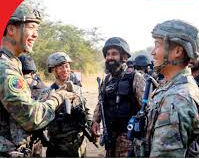
The Chinese People’s Liberation Army (PLA) Western Theatre Command and the Pakistani Army conducted a joint military exercise codenamed Warrior IX. This exercise, held in Pakistan, concluded on December 14th. During the exercise, the Chinese and Pakistani armies jointly practiced counter-terrorism operations. The Chinese military issued a statement saying that the exercise tested their ability to maintain regional peace and stability and further strengthened the traditional friendship between Pakistan and China. The Chinese army is not only collaborating with Pakistan to put pressure on India, but it has also made preparations near the Indian border that would allow it to deploy its troops for war within just 24 to 48 hours.
According to a Swarajya report, continuous PLA military exercises, official speeches, and Chinese military textbooks reveal that Beijing is constantly reducing the deployment time for its troops. China’s objective is clear: to be able to transform normal peacetime military exercises into war preparations within just a few hours. China’s strategy is to encircle the enemy before they can respond. The report states that while the world is focused on the Chinese military’s encirclement of Taiwan, the PLA’s biggest game is being played out on the Indian border.
The Chinese Army’s New Doctrine: ‘Golden Window’
The report says that this change is a result of the Chinese army’s new doctrine, which is now operating under the ‘Golden Window’ plan. The Golden Window refers to the first 24 to 48 hours of any conflict. Within this Golden Window, the Chinese army must complete its full deployment and establish complete control over the entire military operation. Some PLA handbooks also emphasize that victory will depend on firing the first shot within minutes. Chinese President Xi Jinping has repeatedly stated since 2015 that the Chinese armed forces should “start quickly and finish as soon as possible,” while remaining permanently on high alert.
Experts say this is not mere rhetoric. The entire institutional structure of the Chinese military has been transformed. Since the Galwan Valley clash in 2020, China has established National Defense Mobilization Offices across the country, including in the remote regions of Tibet and Xinjiang. These bodies handle administrative tasks, allowing the military to focus on combat operations. The old division-regiment structure is being replaced with combined arms brigades. An integrated command structure is being created that receives real-time data from satellites, drones, and electronic intelligence.
China Increases Military Deployment After Galwan Clash
Since the Galwan clash, the Chinese military has been conducting high-frequency drills in Tibet and Xinjiang to reduce deployment times. In August 2021, the Tibet Military District mobilized approximately 10,000 troops in less than 24 hours. In 2023, troops were mobilized and drilled on the Xinjiang border without any prior announcement. In 2024, PLA air assault and air defense units were put on alert in the Western Theater Command to enable their rapid deployment to high-altitude valleys.
While a Chinese invasion of Taiwan would require highly visible military operations at sea, the situation along the Line of Actual Control (LAC) with India is different. Chinese troops can reach the border quickly and from short distances. This leaves India with very little time to make critical decisions in a crisis. If the Chinese military deploys rapidly, India will have very little time to react. China would not need a full-scale war to alter the border.